






Mathirsty Story-Driven Business eBook
Where to Invest, Where to Exit
Understand the GE–McKinsey Matrix Through a Practical Indian Retail Story
Follow Riya and Arvind as they compare 18 stores, evaluate market potential, measure competitive strength and decide where capital should grow, hold, harvest or exit.
📖 62 Illustrated Pages
◫ Complete 9-Cell Matrix
💻 Digital eBook
Learn the GE–McKinsey Matrix for ₹99
Digital eBook • Retail-Based Story • Beginner-Friendly
When Instinct Is No Longer Enough
A profitable business unit is not always the right place for more investment.
Riya studies reports from 18 stores and finds mixed signals everywhere. One store has strong revenue but falling margins. Another is profitable in a location with declining footfall. A struggling suburban outlet may soon benefit from new housing projects.
Arvind helps her move beyond isolated numbers and see every store as part of one strategic portfolio.
From Conflicting Numbers to Structured Decisions
🌫️
The Problem
Revenue, margins, footfall, market demand and operational performance may point in different directions.
⚖️
The Hidden Cost
Investing equally across every store, product or division can dilute capital and preserve weak positions for too long.
◫
The Structured Solution
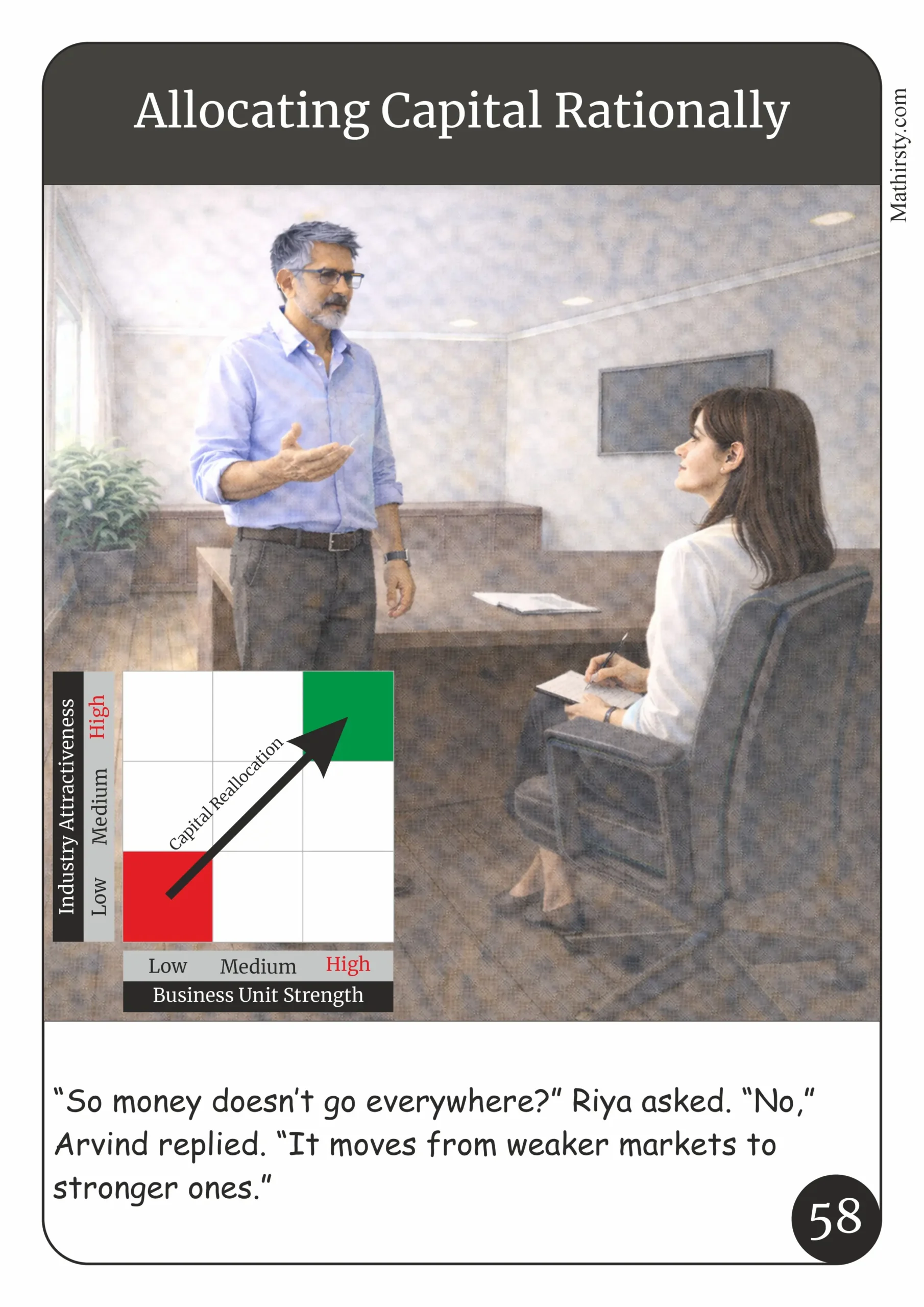
The GE–McKinsey Matrix compares Industry Attractiveness with Business Unit Strength to clarify investment priorities.
Why You’ll Love This eBook
A practical, illustrated introduction to portfolio strategy for readers who want clarity without dense consulting jargon.
🏪
Indian Retail Context
Learn through stores, malls, neighbourhoods, margins, footfall and expansion decisions.
🎨
Illustration-Led Learning
Each matrix position is reinforced through a visual example and mentor-led conversation.
🧠
Beginner-Friendly
Understand the framework without prior consulting, finance or strategy experience.
💰
Capital Allocation Thinking
See why investment should move toward stronger opportunities instead of being spread everywhere.
What This eBook Helps You Understand
✓ Why profitability alone is not enough to justify expansion.
✓ How external market conditions and internal strength must be evaluated together.
✓ Where confident investment can build stronger long-term positions.
✓ When selective investment or careful monitoring is more appropriate.
✓ How harvesting can protect cash without treating decline as immediate failure.
✓ Why emotional attachment should not override portfolio evidence.
Product Features
📄
62 Pages
A complete illustrated journey from the decision problem to portfolio discipline.
👥
Riya and Arvind’s Story
Learn through practical conversations between a decision-maker and an experienced mentor.
◫
Complete 9-Cell Matrix
Understand every high, medium and low combination—not only the broad strategy zones.
📊
Scoring Factors
Explore practical factors for measuring both industry attractiveness and business strength.
Two Dimensions. Nine Positions. Clearer Choices.
The matrix brings an external market view and an internal competitive view together before recommending action.
🌍
Industry Attractiveness
Evaluates the external environment surrounding a store, product, division or market.
Growth rate • Competitive intensity • Profit margins • Long-term demand stability
🏆
Business Unit Strength
Evaluates how competitively powerful the business unit is inside that market.
Market share • Brand loyalty • Cost efficiency • Operational excellence
Three Strategic Zones
The nine cells ultimately support three broader portfolio directions.
↗
Grow / Invest
Direct capital toward attractive markets where the business holds or can build a meaningful competitive position.
⏸
Hold / Selective Investment
Protect profitability, improve efficiency and invest selectively rather than expanding aggressively.
↘
Harvest / Exit
Reduce new investment, recover cash carefully or close weak positions before losses grow.
Perfect for Learning, Analysis and Smarter Portfolio Decisions
Use this GE–McKinsey Matrix eBook when you want to compare multiple stores, products, business units, markets or growth opportunities with greater discipline.
🎤 Presentations
📝 Revision
🏪 Store Portfolios
📊 Product Portfolios
💰 Capital Allocation
🚪 Exit Decisions
🧠 Self-Learning
What’s Included
✓ Complete 62-page digital eBook
✓ Riya and Arvind’s complete retail portfolio story
✓ Industry Attractiveness axis explained
✓ Business Unit Strength axis explained
✓ All nine matrix positions with retail examples
✓ Grow, hold, harvest and exit strategy lessons
✓ Market and strength measurement factors
✓ Capital allocation and emotional-bias lessons
Product Specifications
| Brand | Mathirsty |
| Product | Where to Invest, Where to Exit — GE–McKinsey Matrix eBook |
| Category | Business Education eBook |
| Framework | GE–McKinsey Matrix |
| Product Type | Digital Product |
| Length | 62 pages |
| Learning Style | Story-driven, illustrated and practical |
| Price | ₹99 |
How to Use This eBook
01
Purchase
Complete your one-time purchase for ₹99.
02
Access
Use the digital access supplied through the store’s order process.
03
Follow the Story
Read Riya and Arvind’s journey from mixed signals to portfolio clarity.
04
Apply the Matrix
Compare stores, products, divisions or growth opportunities using both axes.
Who This Is For
Created for learners and decision-makers who want the GE–McKinsey Matrix explained through real operating questions rather than abstract theory.
🎓 BBA, B.Com and MBA students
📘 Management aspirants
🚀 Entrepreneurs and founders
🏪 Retail and multi-store operators
💼 Business professionals
🧠 Visual and practical learners
Why Choose Mathirsty?
Mathirsty simplifies powerful management frameworks through visual stories, practical examples and clear strategic language.
Strong markets are not enough. Strong businesses are not enough. Strategy begins where both meet.
Instead of presenting only a 3×3 chart, this eBook walks through the logic, measurement factors, strategic zones and consequences behind each decision.
Important Usage Notes
💻 This is a digital eBook. No physical book will be shipped.
🔒 Intended for personal learning use.
🚫 Do not reproduce, upload, resell or redistribute.
💾 Save the digital file securely for future learning and revision.
📚 Educational resource, not a promise of academic or business results.
🔄 Portfolio positions should be reviewed because markets and strengths change.
Frequently Asked Questions
Is this GE–McKinsey Matrix eBook beginner-friendly?
Yes. The framework is introduced gradually through a mentor-led retail story and illustrated examples.
What does the GE–McKinsey Matrix measure?
It compares Industry Attractiveness with Business Unit Strength.
How is it different from a simple two-by-two matrix?
The GE–McKinsey Matrix uses nine cells, allowing more nuanced positions across high, medium and low levels on both axes.
What decisions does the framework support?
It helps guide investment, selective improvement, monitoring, harvesting, capital reallocation and exit decisions.
Is this useful only for retail businesses?
The story uses retail stores, but the portfolio logic can help readers understand decisions involving multiple products, divisions, markets or business units.
Is this a physical book?
No. This is a digital eBook. No physical product will be delivered.
Do I need prior strategy knowledge?
No. The book explains the axes, nine cells, strategic zones and measurement factors step by step.
Learn Strategy Through Stories
Capital should not go everywhere. It should go where potential is strongest.
Follow Riya and Arvind as they turn mixed signals into a structured portfolio—and discover where to invest, where to hold, where to harvest and where to exit.
Start Your GE–McKinsey Matrix Journey for ₹99
Digital eBook • 62 Illustrated Pages • Beginner-Friendly




Reviews
There are no reviews yet.